Showing posts with label Eliot Schrefer. Show all posts

Friday, January 19, 2018

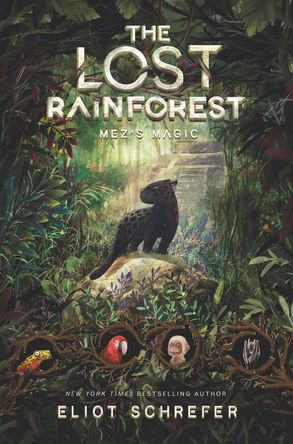
Mez's Magic (The Lost Rainforest Book 1) by Eliot Schrefer

For our first review of the new year, I am proud to present my new blogging assistant in charge of middle grades reviews: my 10 year old son, Ian.  Ian loves to read and he is super excited to share his love for his new favorite book!  So, without further ado, here's Ian with his first published review!

Goodreads Blurb:
The Lion King meets Wings of Fire in the magical rainforest kingdom of Caldera in this new middle grade animal fantasy series from New York Times bestselling author and National Book Award finalist Eliot Schrefer.


Caldera has forever been divided into those animals who walk by night and those who walk by day. Nightwalker panthers, like young Mez and her beloved sister, have always feared daywalkers as creatures of myth and legend. Until the eclipse.


Now Mez has discovered that she can cross the Veil and enter the daylight world. Her magical power has unknown depths, but she must rush to discover it after a mysterious stranger arrives at her family’s den, bearing warnings of a reawakened evil.


Saving Caldera means Mez must leave her sister behind and unite an unlikely group of animal friends to unravel an ancient mystery and protect their rainforest home.

So for most of the book there is a light hearted feeling but it turns darker closer to the end but then it is happy at the end for the most part the whole book is shrouded in mystery. The characters are funny, smart, and quirky. The main characters are cool too Mez, the calico who doesn't know she has magic but trust me she does, Lima the happy bat, she is super happy all of the time except except when she is not, then there is the frog Rumi, the smart and nerdy frog has always does boring stuff but it pays off in the end ,then there is this monkey guy who is funny he is the comic relief. The best part is all of it!!!I am excited for the next one because of  the ending!!!!!!!

I give Mez's Magic 5 Fairies for a great read that he just could not put down!  You can find Eliot Schrefer on his website and you can add The Lost Rainforest: Mez's Magic on Goodreads.


Thursday, December 13, 2012

BIR 2012: Endangered by Eliot Schrefer


The first book that I have to feature today is Endangered by Eliot Schrefer.  I first heard about this book when Eliot appeared at the Teen Author Carnival that coincided with BEA 2012.  When I saw that he had a signing later in the week, I just HAD to get this book.  I love bonobos and primates in general so this book was right up my alley.  You can find my review of Endangered here.

I got to talk to Eliot about the book, the need for conservation, and his interactions with bonobos.

If we should all take one lesson from our cousins the bonobos, what would you say that it is?

Bonobos are awesome in so many ways. For starters, they are highly social, pacifist, vegetarian apes with an infinite interest in connecting to one another and very little interest in dominating their environment or warring among themselves.

My favorite thing about bonobos is that they "make war" far less often than their chimp cousins. Chimps tend to solve conflicts with teeth and harm while bonobos... well, let's just say that is not their way. What is your favorite thing about bonobos?

Bonobos and chimps share the billing as our nearest living relatives. But they treat one another very differently. Throw food into a chimpanzee social group, and the dominant males will split it up among their favorites. Throw food into a bonobo social group, and the females will collectively prevent the stronger males from nabbing it. Then everyone will get very tense about what’s going to happen next. They’ll present to one another, rubbing their bodies until they’ve been reminded of their intimacy and bonding. Sated and blissed-out, only then will they approach the food source. And they’ll share it widely, with infants even eating out of the mouths of strong males.

Next, Eliot and I will dicuss this clip. http://www.eliotschrefer.com/PlayingGames.wmv

The clip makes me wonder what I must look like in the evenings when I end up trying to read in my chair and my three youngest kids decide to try to join me. Young bonobos seem to play very like young humans. What in this interaction between you and the bonobos is similar to an interaction with humans and what is different?

It was very similar, I’d say. The young bonobos spend their days with the same surrogate mothers, and were so excited to have someone new to play with. So I was the main attraction for 20 minutes, until they got bored and moved away. One big difference is that bonobo bodies are sturdier than ours, so the play often got rough. One or two thought it was fun to bite, in a way that wouldn’t have been a problem for another bonobo, but broke my skin! So I have a little bonobo scar.

I love how curious the one bonobo seems to be as he gets in your face. What is he trying to convey with the open mouth there?

They love being blown on. Giving a big raspberry in the belly is especially popular. I think he just was trying to figure out the parameters of our improvised game.

How heavy was your lap full of apes? They look so muscular and heavy.

They are incredibly dense, and have much less body fat than humans. That’s part of why they’re so strong, and also explains why they can’t swim—they sink right away!

The one lesson in Endangered that I hope EVERYONE will take to heart is that buying animals to take them out of a bad situation is never the answer. You see it in America all the time, people who "save" animals from dirty pet stores or bad quality breeders by buying them. When you buy these animals, you feed the system. You "save" one animal, while opening man more to the same fate. In Endangered, buying a bonobo from a poacher makes him money so he takes two more from their mothers in an attempt to make more money. Sophie gives Otto a chance at life at the cost of other bonobos' lives. What SHOULD people do to make a real difference in the animal trade?

That summer I was in Congo, I cradled an orphan whose primary needs were connection to others, a source of fruit, and the opportunity to live in the forest without being hunted. Humans had taken all of that from him, but he still held tightly to my chest, hoping despite everything for love and sustenance. My affection for that infant was only intensified by my guilt that our modern human existence comes with so many invisible, far-reaching costs. I think the most important thing is to avoid supporting systems—like puppy mills or testing—that do wrong. And also to think about long-term consequences of short-term good deeds.


I'm lucky enough to have actually seen a bonobo in person. The nearby Columbus Zoo here in Ohio has a colony of bonobos. When I took Vertebrate Biology in college, we went to sit and takes notes on their behavior. At the time, the 17 year leader of the group was being challenged by another female. The process was fascinating. The zoo also had the only set of bonobo twins (born in captivity) born there. What brought the bonobos and their plight into your life?

A pair of pants! I bought some Bonobo slacks, and thought it was a nonsense word. Then I looked them up online and was instantly hooked. I’m so glad the Columbus Zoo has a big bonobo population. With Congo’s uncertain future, it’s so important that zoos maintain healthy breeding groups.

The recurring question in Endangered seems to be WHY. WHY should we help these apes when people are in need? Why do you think it is important for us to help these apes, even in the face of human suffering?

Bonobos also have an exquisitely broad range of emotions. Unlike chimpanzees, they will willingly enter water. One of my favorite bonobos from the sanctuary loved a particular flat rock in the middle of the pond. He’d stand at the water’s edge and pluck up his courage before gingerly entering. Holding his arms over his head to make sure they stayed dry, he got a grossed-out look on his face as he tiptoed through sludge and pond goo. But then he’d get to spend the afternoon on his sun-warmed rock. Sometimes he’d find a water bottle that had blown into the enclosure, fill it, and take occasional sips as he enjoyed the sunshine. The feelings he expressed—from squeamishness about the dank water to bliss at having nothing to do but enjoy the sunshine—were so wonderfully akin to a human’s.
I think the answer is in there—that many of the distinctions humankind has long made between people and animals are artificial and morally unclear. And the systems that produce human and animal suffering (case in point, the current conflict in Congo) are much the same.


Now the question is how can we help the bonobos?

One place to start is to visit Friends of Bonobos (http://www.friendsofbonobos.org). You can adopt a bonobo there! Any funds you could contribute or give as a gift will go to keeping a young orphan bonobo alive at the sanctuary in Congo.


This has been fun! Thanks for the great questions.

Thank you so much for taking the time to talk to me about Endangered and Bonobos, Eliot!

Now for our giveaway! I have one copy of Endangered to give away to one reader in the US/CAN. Rafflecopter is not cooperating today so let's just use comments. Just leave a comment on this post with your email address. We'll keep it easy.

Sunday, September 2, 2012

Endangered by Eliot Schrefer

For those of you who don't know, I have a biology degree.  My main ambition when I graduated from college was to work with primates.  I first saw bonobos in 2003 when I took Vertebrate Biology.  We took a trip to the Columbus, Ohio Zoo where we got to go behind the scenes in the buildings as well as speak to the different keepers.  We took about an hour and a half to observe the colony of bonobos at the zoo and then compare their behaviors to those of the chimpanzees.  Bonobos are generally peaceful and caring apes. I wished that I knew more humans who acted like the bonobos.  Chimpanzees and humans share some unfortunate behaviors like rape, murder and war.  I had the immense good fortune to see Eliot Schrefer at the Teen Author Carnival during BEA.  I was so excited about Endangered after hearing him talk about it that I made sure to get in line for a signed ARC.  This book did not disappoint!  Here is the Goodreads blurb:

The compelling tale of a girl who must save a group of bonobos--and herself--from a violent coup. The Congo is a dangerous place, even for people who are trying to do good. When one girl has to follow her mother to her sancuary for bonobos, she's not thrilled to be there. It's her mother's passion, and she'd rather have nothing to do with it. But when revolution breaks out and their sanctuary is attacked, she must rescue the bonobos and hide in the jungle. Together, they will fight to keep safe, to eat, and to survive. Eliot Schrefer asks readers what safety means, how one sacrifices to help others, and what it means to be human in this new compelling adventure.
I tore through this book over the course of an evening.  This book reminded me of so many things.  I remember being at the Cleveland Zoo once and sitting through the chimpanzee's Meet the Keeper time.  The largest male chimp held down a much smaller female chimp and raped her repeatedly over the course of the 30 minute question and answer period.  The keeper explained that it was an assertion of dominance and that the female would be fine.  It was one of their behaviors.  That small female had been hand reared by another keeper and taught to sign.  She asked the keeper for a cookie at one point during the talk.  I remember feeling so sad that an animal with such intelligence had such violent tendencies... so much like humans.  Neither animal is perfect, they are animals with animal behaviors.  Bonobos will attack other bonobos and humans when scared, stressed or threatened.  Jane Goodall has been one of my greatest heroes so I do love chimpanzees as well.  I just hate to see the parallels between humans and our ape relatives sometimes.  There is definitely a parallel in Endangered as it occurs in the war torn Congo where safety is tenuous at best.  The humans in Congo, like other places in Africa, have to worry about dictators taking over and civil unrest as warlords battle for control.  It is a scary situation for sure.  The bonobos are found in Congo and not many other places in the world (most are in zoos).  The bonobos are endangered and if war were to break out, it could decimate their populations and set back the conservation efforts of those trying to save them.  This book also touches on something very near to my heart, the idea of "saving" animals.  I've worked with rescue efforts before and the main thing that I have learned is that purchasing animals from puppy mills, unscrupulous pet stores or the black market is not helping.  You may keep one or two animals alive but you are feeding the system.  It hurts to leave these animals in bad conditions but legal avenues is the only way to bring about REAL change.  This is something that Sophie must learn when she takes responsibility for Otto, a young bonobo.  I've always liked animals better than I like most people so I've never understood how someone can look at a chimp or bonobo and not see the humanity in them.  Sophie doesn't at first either but Otto teaches her.  She also has to face the question of humans versus animals in another way.  While Sophie refuses to leave Otto to fend for himself, people ask why would you put him before all of the humans in need of help.  To me, the answer is simple.  If we work to save the environment and the animals in it, we are really working to save ourselves.  Humans can not survive on a planet that is unhealthy.  When animals thrive, so will we.  The great apes also give us the opportunity to examine what separates us from them and what humanity really is.  Are humans and apes so different?  Not really.  Look into an ape's eyes and you can see yourself in them.  I really feel like Eliot Schrefer has done something amazing and brought a story that needed to be told to the Young Adult audience.  Everyone should read this book.

You can find out more about Eliot Schrefer on his website.  You can also find out more about bonobos on the Friends of Bonobos site.  Click here to add Endangered to your Goodreads.  I give this book 5 Fairies and it is definitely on my best of 2012 list!